
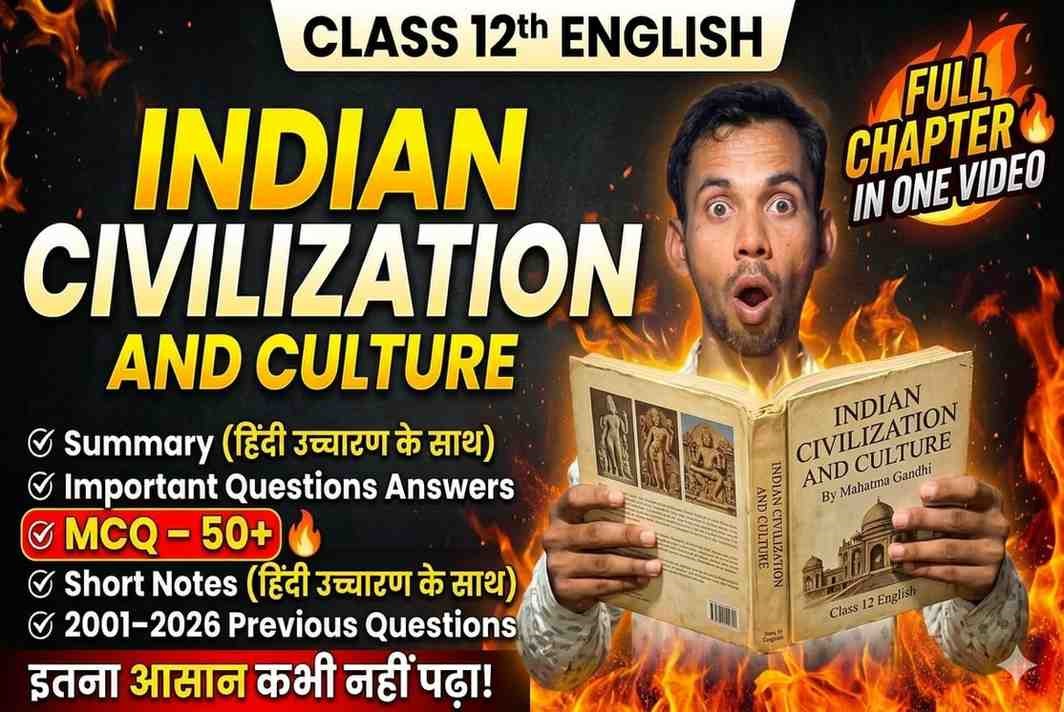
Class 12 English Indian Civilization and Culture Notes
इस chapter में आपको summary, MCQ, important questions और previous year questions मिलेंगे।
📌 Summary of Indian Civilization and Culture
📌 Hindi Explanation of Indian Civilization and Culture
📌 Important Questions (Short & Long)
📌 MCQ Questions and Answers📌 Previous Year Questions (Bihar Board)
📌 Important Points for Exam
📌 Conclusion भाषा में

- Indian Civilization and Culture – महात्मा गांधी
- Bharat is My Home – जाकिर हुसैन
- A Pinch of Snuff – मनोहर मालगोनकर
- I Have a Dream – मार्टिन लूथर किंग जूनियर
- Ideas that have Helped Mankind – बर्ट्रेंड रसेल
- The Artist – शिगा नोया
- A Child is Born – जर्मेन ग्रीर
- How Free is the Press – डोरोथी एल सेयर्स
- The Earth – एच. ई. बेट्स
- India Through a Traveller’s Eyes – पर्ल एस. बक
- The Marriage Proposal – एंटोन चेखव
- Sweetest Love, I Do Not Goe – जॉन डन
- Song of Myself – वॉल्ट व्हिटमैन
- Now the Leaves are Falling Fast – डब्ल्यू. एच. ऑडेन
- Ode to Autumn – जॉन कीट्स
- An Epitaph – वाल्टर डे ला मेयर
- The Soldier – रूपर्ट ब्रुक
- Macavity: The Mystery Cat – टी. एस. एलियट
- Fire-Hymn – के. एन. दारूवाला
- Snake – डी. एच. लॉरेंस
- My Grandmother’s House – कमला दास
- व्याकरण: टेंस, वॉइस, नरेशन, प्रीपोज़िशन, स्पेलिंग, आर्टिकल, सिनोनिम्स/एंटोनिम्स, आदि।
- लेखन: एस्से (निबंध), लेटर राइटिंग, और अनसीन पैसेज।
- कुल अंक: 100
- ऑब्जेक्टिव (वस्तुनिष्ठ): 50% प्रश्न (बहुविकल्पीय – MCQ)
- सब्जेक्टिव (व्यक्तिपरक): 50% प्रश्न (व्याख्या और प्रश्न-उत्तर)
Top-60 MCQ Questions and Answers📌 Previous Year Questions (Bihar Board)
1. According to Gandhi, what is the real test of civilization?
A. Increase of wants
B. Decrease of wants ✅
C. Industrial growth
D. Political power
2. Why does Gandhi call modern civilization “irreligion”?
A. It supports religion
B. It ignores morality and spirituality ✅
C. It promotes peace
D. It teaches simplicity
3. What is the hidden danger of machinery?
A. Cost
B. Time
C. Loss of independence and morality ✅
D. Noise
4. Why does Gandhi oppose large-scale industrialization?
A. It creates jobs
B. It increases wealth
C. It leads to exploitation and moral decline ✅
D. It is slow
5. What is the paradox of desires according to Gandhi?
A. More desires = more happiness
B. Less desires = less happiness
C. More desires = more unrest ✅
D. Desires don’t matter
6. What does Gandhi mean by “mind is a restless bird”?
A. Mind is weak
B. Mind becomes more unsatisfied as desires increase ✅
C. Mind is stable
D. Mind is powerful
7. Why did ancestors prefer villages over cities?
A. Cities were small
B. Villages ensured moral and simple life ✅
C. Cities were unknown
D. Villages were rich
8. What is Gandhi’s view on material comfort?
A. Always necessary
B. Always harmful
C. Good only within limits ✅
D. Best for happiness
9. What does Gandhi suggest about Western civilization?
A. Fully adopt
B. Completely reject
C. Critically accept useful parts ✅
D. Ignore
10. What is the root cause of modern problems?
A. Poverty
B. Ignorance
C. Unlimited wants and materialism ✅
D. Population
11. According to Gandhi, what destroys moral values?
A. Religion
B. Simplicity
C. Blind imitation of the West ✅
D. Villages
Bihar Board class 12th hindi Digant bhag 2 lesson 01 Batchit बातचीत
12. What is the true meaning of self-rule (Swaraj)?
A. Political independence
B. Rule by leaders
C. Self-control and moral discipline ✅
D. Foreign rule
13. Why is modern civilization called “a disease”?
A. It spreads fast
B. It weakens moral and spiritual life ✅
C. It is powerful
D. It is new
14. What is the contradiction in modern life?
A. Less work, more peace
B. More comfort, less happiness ✅
C. Less wealth, more joy
D. More villages
15. What does Gandhi mean by “voluntary poverty”?
A. Being poor
B. Living simply by choice ✅
C. Losing money
D. Avoiding work
Chapter 1 – Push Ki Raat (पूस की रात) Class 11 Hindi Notes | Summary, MCQ, Question Answer
16. Why does Gandhi criticize doctors and lawyers?
A. They are uneducated
B. They exploit people’s weaknesses indirectly ✅
C. They are poor
D. They avoid work
17. What is the core strength of Indian civilization?
A. Economy
B. Army
C. Spiritual and moral values ✅
D. Technology
18. What is the impact of competition?
A. Unity
B. Peace
C. Conflict and stress ✅
D. Growth only
19. What does Gandhi say about true happiness?
A. Comes from wealth
B. Comes from power
C. Comes from inner satisfaction ✅
D. Comes from luxury
20. Why is Indian civilization called “eternal”?
A. It is rich
B. It has survived due to strong moral base ✅
C. It is modern
D. It is westernized
English Grammar MCQ 2026 for Bihar Board Class 9-12 (2000+ Questions)
21. What does Gandhi consider the greatest weakness of modern civilization?
A. Lack of money
B. Dependence on machines and comforts ✅
C. Lack of education
D. Less population
22. Why does Gandhi discourage blind imitation?
A. It wastes time
B. It destroys originality and moral values ✅
C. It is costly
D. It is difficult
23. What is the real meaning of progress according to Gandhi?
A. Industrial growth
B. Scientific development
C. Moral and spiritual upliftment ✅
D. Urbanization
24. Why does Gandhi prefer self-sufficiency?
A. For wealth
B. For independence and moral strength ✅
C. For power
D. For comfort
25. What is the danger of luxury?
A. Comfort
B. Laziness
C. Weakens character and increases desires ✅
D. Wealth
26. What does Gandhi say about education?
A. It should focus only on jobs
B. It should build character and morality ✅
C. It should be modern only
D. It should be technical
27. What is the main aim of human life?
A. Earning money
B. Gaining power
C. Moral and spiritual growth ✅
D. Competition
28. What is the effect of unlimited competition?
A. Unity
B. Peace
C. Conflict and dissatisfaction ✅
D. Growth
29. Why does Gandhi criticize railways and technology?
A. They are slow
B. They spread diseases and moral evils faster ✅
C. They are costly
D. They are useless
30. What is the ideal lifestyle suggested by Gandhi?
A. Luxurious
B. Modern
C. Simple and self-controlled ✅
D. Busy
31. What is the root of all evils in modern society?
A. Ignorance
B. Poverty
C. Unlimited desires ✅
D. Illiteracy
32. What does Gandhi mean by true freedom?
A. Political power
B. Economic growth
C. Control over self and desires ✅
D. Foreign rule
33. Why is Indian civilization superior according to Gandhi?
A. Wealth
B. Army
C. Moral and spiritual values ✅
D. Technology
English Grammar MCQ 2026 for Bihar Board Class 9-12 (2000+ Questions)
34. What is the impact of materialism?
A. Happiness
B. Peace
C. Moral degradation ✅
D. Satisfaction
35. What does Gandhi say about happiness and wealth?
A. Wealth = happiness
B. Wealth always gives joy
C. Wealth cannot ensure happiness ✅
D. Wealth is necessary
36. What is the main teaching of Indian culture?
A. Luxury
B. Competition
C. Self-control and simplicity ✅
D. Power
37. Why does Gandhi oppose over-dependence on machines?
A. Expensive
B. Reduces human effort
C. Makes humans weak and dependent ✅
D. Slow
38. What is the true measure of success?
A. Wealth
B. Fame
C. Character and morality ✅
D. Power
39. What does Gandhi suggest about modern inventions?
A. Always good
B. Always bad
C. Useful only with moral control ✅
D. Must be avoided
English Grammar MCQ 2026 for Bihar Board Class 9-12 (2000+ Questions)
40. What is the final goal of civilization?
A. Comfort
B. Wealth
C. Moral perfection and self-realization ✅
D. Technology
41. What leads to peace according to Gandhi?
A. Wealth
B. Power
C. Self-control and simplicity ✅
D. Competition
42. What is harmful beyond limit?
A. Work
B. Study
C. Material comfort ✅
D. Simplicity
43. What does Gandhi say about inventions?
A. Always useful
B. Always harmful
C. Dangerous if misused ✅
D. Necessary
44. What kind of life gives happiness?
A. Luxurious
B. Simple and controlled ✅
C. Busy
D. Competitive
45. What is the role of religion in Indian civilization?
A. No role
B. Minor role
C. Major role in moral life ✅
D. Political role
46. What does ‘contentment’ mean?
A. Wealth
B. Satisfaction ✅
C. Power
D. Growth
English Grammar MCQ 2026 for Bihar Board Class 9-12 (2000+ Questions)
47. What is the opposite of contentment?
A. Peace
B. Happiness
C. Greed and desire ✅
D. Love
48. What destroys happiness?
A. Simplicity
B. Morality
C. Unlimited desires ✅
D. Religion
49. What is Gandhi’s teaching?
A. Live richly
B. Follow modern life
C. Live simply and think highly ✅
D. Earn more
50. What is the final message of the lesson?
A. Follow Western culture
B. Increase wealth
C. Simple living and moral life ✅
D. Build cities
51. What is the real duty of man according to Gandhi?
A. Earn money
B. Follow morality and self-control ✅
C. Gain power
D. Live luxuriously
52. What does Gandhi criticize about modern education?
A. Costly
B. Ignores moral development ✅
C. Difficult
D. शार्ट
https://www.youtube.com/@jccenter7061/featured
53. What is the main cause of restlessness?
A. Poverty
B. Wealth
C. Unlimited desires ✅
D. Work
54. What is the true source of satisfaction?
A. Money
B. Luxury
C. Contentment of mind ✅
D. Power
55. Why does Gandhi support simple tools?
A. Cheap
B. Easy
C. Maintain independence and morality ✅
D. Fast
56. What is the impact of industrialization?
A. Peace
B. Moral upliftment
C. Exploitation and inequality ✅
D. Satisfaction
57. What does Gandhi say about modern comforts?
A. Always useful
B. Harmful if excessive ✅
C. Necessary
D. Best
58. What is the role of self-restraint?
A. Increase desires
B. Control mind and bring peace ✅
C. Earn wealth
D. Compete
59. What is true progress according to Gandhi?
A. More machines
B. More cities
C. Moral and ethical growth ✅
D. More wealth
60. Why does Gandhi oppose the race for wealth?
A. Difficult
B. Costly
C. Leads to moral downfall ✅
D. Slow
INDIAN CIVILIZATION AND CULTURE – QUESTIONS & ANSWERS
B.1.1 Complete the following sentences:
a) India’s glory is that it …
Answer: India’s glory is that it remains immovable and steady.
b) The charge against India is that …
Answer: The charge against India is that her people are uncivilized, ignorant and do not accept change.
c) We dare not change what …
Answer: We dare not change what we have tested and found true on the anvil of experience.
d) Our ancestors set a limit to our indulgences because …
Answer: Our ancestors set a limit because they believed happiness is a mental condition and unlimited desires bring unhappiness.
e) Our forefathers did not invent machinery because …
Answer: Our forefathers did not invent machinery because they feared it would make people slaves and destroy moral values.
B.1.2 Answer the following questions briefly
1) How is Indian civilization different from European civilization?
Answer: Indian civilization focuses on self-control, morality and spiritual life, while European civilization focuses on material progress and comfort.
2) Why does Gandhi say that ‘mind is a restless bird’? What makes the mind restless?
Answer: The mind is restless because the more we get, the more we want. Desires and passions make it restless.
3) Why did our ancestors dissuade us from luxuries and pleasures? Did they do the right thing?
Answer: They discouraged luxuries because they lead to unhappiness and loss of control. Yes, they did the right thing.
4) Why have we stuck with the same kind of plough? Should we do the same today?
Answer: We stuck with it because ancestors avoided machinery to protect moral values. Today, we can improve tools but keep values.
5) How did our ancestors view large cities? Why were they satisfied with small villages?
Answer: They saw cities as dangerous and full of crime. Villages were simple, safe and peaceful.
6) How did our ancestors enjoy true ‘Home Rule’?
Answer: They lived independently and followed their work freely, so they enjoyed real freedom.
INDIAN CIVILIZATION AND CULTURE – FULL EXERCISE ANSWERS
B.2 Answer the following questions briefly
Q1. What, according to the author, is modern civilization?
Answer: Modern civilization is the worship of material things. It focuses only on physical comfort and ignores moral and spiritual values.
Q2. What did the author convey to the countrymen about dealing with modern civilization?
Answer: The author advised his countrymen to avoid modern civilization and not follow it blindly.
Q3. What is the distinguished characteristic of modern civilization?
Answer: The main characteristic is the unlimited increase of human wants.
Q4. The author perceived danger from modern inventions. How?
Answer: The author felt that modern inventions make people greedy and addicted to comfort, which is dangerous.
Q5. What does the author prefer to materialism?
Answer: The author prefers spiritual values and simple living over materialism.
Q6. What does our civilization depend upon?
Answer: Our civilization depends on self-control and limiting our wants.
Q7. What is civilization in the real sense of the term?
Answer: Real civilization means controlling desires and living a moral life.
Ex. 2 Fill in the blanks (Gerunds)
(i) Pragya’s writing is not very legible.
(ii) The police could not control the maddening crowd.
(iii) We are in danger of bartering away the permanent good for a momentary pleasure.
(iv) Gandhi always believed in simple living.
(v) Amandeep’s thinking was quite logical.
D.4 Phrases (Use in sentences)
1. satisfy with – I am satisfied with my result.
2. be suited to – This job is suited to him.
3. believe in – I believe in hard work.
4. cling to – We should cling to our culture.
5. in vain – His efforts went in vain.
E. Grammar Ex. 1 (Correct form of verbs)
a) Indian Civilization has kept it alive till now.
b) I see here ancient India still living.
c) We have borrowed many things from western literature.
d) We have been copying west since long.
e) Arya did speak so.
f) Nehru had written so many letters to his daughter from jail.
Ex. 2 (Double Comparative – 10 sentences)
1. The more you study, the better you learn.
2. The harder you work, the more success you get.
3. The more he earns, the more he spends.
4. The faster you run, the earlier you reach.
5. The more we practice, the better we perform.
6. The less you worry, the happier you feel.
7. The more she reads, the smarter she becomes.
8. The higher you go, the cooler it becomes.
9. The more you give, the more you receive.
10. The earlier you sleep, the fresher you feel.
D.1 Dictionary Use (Correct spelling)👉 “Class 12 English Notes”
dissuaded
occupation
votaries
immorality
materialism
belief
maddening
engrave
harmony
unadulterated
D.2 Word Formation (Abstract nouns + sentences)
1. conversion – The conversion was successful.
2. performance – His performance was excellent.
3. definition – The definition is clear.
4. pleasure – Reading gives me pleasure.
5. education – Education is important.
6. observation – His observation was correct.
D.3 Word Meaning
ancestor – someone related long ago
indigenous – of one’s homeland
encumbrance – burden
propagate – spread ideas
stolid – slow-witted
dissuade – advise against
barter – exchange goods
C.3 कम्पोजीशन 👉 “Class 12 English Notes”
(a) The real dignity of man lies not in what he has but in what he is.
Answer: A man’s dignity is not based on wealth or power but on his character. A rich man without values is not respected, while a poor man with honesty and kindness is admired. Good behavior, truthfulness, and moral values make a person great. Therefore, true dignity lies in one’s character, not in material possessions.
(b) The crown and glory of life is character.
Answer: Character is the most important thing in life. It gives respect and honor to a person. Without character, success has no value. A person with strong character is always trusted and respected by others. Good habits, honesty, and discipline build strong character. Thus, character is the real glory of life.
INDIAN CIVILIZATION AND CULTURE – SUMMARY (With Hindi Pronunciation)
Indian civilization is based on moral and spiritual values.
(इंडियन सिविलाइजेशन इज बेस्ड ऑन मॉरल एंड स्पिरिचुअल वैल्यूज़) “Class 12 English Indian Civilization and Culture Notes Summary”
It teaches people to control their desires and live a simple life (इट टीचेस पीपल टू कंट्रोल देयर डिज़ायर्स एंड लिव अ सिंपल लाइफ)
The author says that modern civilization focuses mainly on material things and increases human wants, which makes people greedy.
(दी ऑथर सेज़ दैट मॉडर्न सिविलाइजेशन फोकसेज़ मेनली ऑन मटेरियल थिंग्स एंड इंक्रीज़ेज ह्यूमन वॉन्ट्स, विच मेक्स पीपल ग्रीडी)
Although modern inventions provide comfort, they also create many problems in life.
(ऑल्थो मॉडर्न इन्वेंशन्स प्रोवाइड कम्फर्ट, दे ऑल्सो क्रिएट मैनी प्रॉब्लम्स इन लाइफ)
The author advises people not to blindly follow Western civilization.
(दी ऑथर एडवाइज़ेस पीपल नॉट टू ब्लाइंडली फॉलो वेस्टर्न सिविलाइजेशन) https://www.youtube.com/@jccenter7061/featured
He believes that Indian civilization is better because it teaches self-control, discipline, and morality.
(ही बिलीव्स दैट इंडियन सिविलाइजेशन इज बेटर बिकॉज़ इट टीचेस सेल्फ कंट्रोल, डिसिप्लिन एंड मोरैलिटी)
Our ancestors lived simple and happy lives by limiting their needs and avoiding luxury.
(आवर एन्सेस्टर्स लिव्ड सिंपल एंड हैप्पी लाइव्स बाय लिमिटिंग देयर नीड्स एंड अवॉइडिंग लक्ज़री)
They believed that true happiness depends on the state of mind, not on wealth.
(दे बिलीव्ड दैट ट्रू हैप्पीनेस डिपेंड्स ऑन द स्टेट ऑफ माइंड, नॉट ऑन वेल्थ)
According to the author, real civilization means controlling desires and living an ethical life.
(अकॉर्डिंग टू दी ऑथर, रियल सिविलाइजेशन मीन्स कंट्रोलिंग डिज़ायर्स एंड लिविंग एन एथिकल लाइफ)
Unlimited wants can destroy society, so people should follow simple living and high thinking.
(अनलिमिटेड वॉन्ट्स कैन डिस्ट्रॉय सोसाइटी, सो पीपल शुड फॉलो सिंपल लिविंग एंड हाई थिंकिंग)
In the end, the author concludes that Indian civilization is strong, valuable, and more meaningful than modern materialistic life.
(इन दी एंड, दी ऑथर कन्क्लूड्स दैट इंडियन सिविलाइजेशन इज स्ट्रॉन्ग, वैल्यूएबल एंड मोर मीनिंगफुल दैन मॉडर्न मटेरियलिस्टिक लाइफ)
INDIAN CIVILIZATION AND CULTURE – SUMMARY
Indian civilization is based on moral and spiritual values. It teaches people to control their desires and live a simple life. The author says that modern civilization focuses mainly on material things and increases human wants, which makes people greedy. Although modern inventions provide comfort, they also create many problems in life.
The author advises people not to blindly follow Western civilization. He believes that Indian civilization is better because it teaches self-control, discipline, and morality. Our ancestors lived simple and happy lives by limiting their needs and avoiding luxury. They believed that true happiness depends on the state of mind, not on wealth.
According to the author, real civilization means controlling desires and living an ethical life. Unlimited wants can destroy society, so people should follow the idea of simple living and high thinking. In the end, the author concludes that Indian civilization is strong, valuable, and more meaningful than modern materialistic life.
INDIAN CIVILIZATION AND CULTURE – IMPORTANT LONG QUESTIONS & ANSWERS(With Hindi Pronunciation)
Q1. What is Indian civilization based on? Explain.
Answer: Indian civilization is based on moral and spiritual values. It teaches people to control their desires, follow truth, and live a simple and disciplined life. It focuses more on inner development rather than material progress.
(इंडियन सिविलाइजेशन इज बेस्ड ऑन मॉरल एंड स्पिरिचुअल वैल्यूज़। इट टीचेस पीपल टू कंट्रोल देयर डिज़ायर्स, फॉलो ट्रुथ एंड लिव अ सिंपल एंड डिसिप्लिन्ड लाइफ। इट फोकसेज़ मोर ऑन इनर डेवलपमेंट रादर दैन मटेरियल प्रोग्रेस)
Q2. What does civilization mean according to Gandhi?
Answer: According to Gandhi, civilization means good conduct and self-control. It does not mean having more wealth or luxury. Real civilization teaches people to control their desires and live a moral and ethical life.
(अकॉर्डिंग टू गांधी, सिविलाइजेशन मीन्स गुड कंडक्ट एंड सेल्फ कंट्रोल। इट डज़ नॉट मीन हैविंग मोर वेल्थ ऑर लक्ज़री। रियल सिविलाइजेशन टीचेस पीपल टू कंट्रोल देयर डिज़ायर्स एंड लिव अ मोरल एंड एथिकल लाइफ)
Q3. Why did our ancestors limit their wants? Explain.
Answer: Our ancestors limited their wants because they believed that unlimited desires bring unhappiness and restlessness. They knew that true happiness depends on the state of mind, not on material things. So, they lived a simple and peaceful life.
(आवर एन्सेस्टर्स लिमिटेड देयर वॉन्ट्स बिकॉज़ दे बिलीव्ड दैट अनलिमिटेड डिज़ायर्स ब्रिंग अनहैप्पीनेस एंड रेस्टलेसनेस। दे न्यू दैट ट्रू हैप्पीनेस डिपेंड्स ऑन द स्टेट ऑफ माइंड, नॉट ऑन मटेरियल थिंग्स। सो, दे लिव्ड अ सिंपल एंड पीसफुल लाइफ)
Class 12 English Indian Civilization and Culture Notes
Q4. What is modern civilization according to Gandhi?
Answer: According to Gandhi, modern civilization is materialistic. It focuses on physical comfort and luxury. It increases human wants and makes people greedy. It ignores moral and spiritual values, so it is harmful to society.
(अकॉर्डिंग टू गांधी, मॉडर्न सिविलाइजेशन इज मटेरियलिस्टिक। इट फोकसेज़ ऑन फिजिकल कम्फर्ट एंड लक्ज़री। इट इंक्रीज़ेज ह्यूमन वॉन्ट्स एंड मेक्स पीपल ग्रीडी। इट इग्नोर्स मोरल एंड स्पिरिचुअल वैल्यूज़, सो इट इज हार्मफुल टू सोसाइटी)
Q5. What is the difference between Indian and Western civilization? 👉 “Class 12 English Notes”
Answer: Indian civilization is based on morality, self-control, and spiritual life, while Western civilization focuses on material progress, comfort, and luxury. Indian culture teaches simple living, whereas Western culture encourages more desires and competition.
(इंडियन सिविलाइजेशन इज बेस्ड ऑन मोरैलिटी, सेल्फ कंट्रोल एंड स्पिरिचुअल लाइफ, व्हाइल वेस्टर्न सिविलाइजेशन फोकसेज़ ऑन मटेरियल प्रोग्रेस, कम्फर्ट एंड लक्ज़री। इंडियन कल्चर टीचेस सिंपल लिविंग, व्हेयरऐज़ वेस्टर्न कल्चर एंकरेजेज मोर डिज़ायर्स एंड कंपटीशन)
Q6. Why did our ancestors avoid machinery? Explain.
Answer: Our ancestors avoided machinery because they believed it would make people lazy and dependent. It could also destroy moral values and make humans slaves of comfort and luxury.
(आवर एन्सेस्टर्स अवॉइडेड मशीनरी बिकॉज़ दे बिलीव्ड इट वुड मेक पीपल लेज़ी एंड डिपेंडेंट। इट कुड ऑल्सो डिस्ट्रॉय मोरल वैल्यूज़ एंड मेक ह्यूमन्स स्लेव्स ऑफ कम्फर्ट एंड लक्ज़री)
Q7. What is true happiness according to the author?
Answer: True happiness depends on the state of mind. It does not depend on wealth or material comforts. A person who controls desires and lives simply remains happy and peaceful.
(ट्रू हैप्पीनेस डिपेंड्स ऑन द स्टेट ऑफ माइंड। इट डज़ नॉट डिपेंड ऑन वेल्थ ऑर मटेरियल कम्फर्ट्स। अ पर्सन हू कंट्रोल्स डिज़ायर्स एंड लिव्स सिंपली रिमेन्स हैप्पी एंड पीसफुल)
Q8. What is the message of the lesson? Explain.
Answer: The message of the lesson is that we should live a simple life and control our desires. We should not blindly follow modern civilization. Instead, we should follow moral values, self-control, and spiritual life.
(दी मैसेज ऑफ द लेसन इज दैट वी शुड लिव अ सिंपल लाइफ एंड कंट्रोल आवर डिज़ायर्स। वी शुड नॉट ब्लाइंडली फॉलो मॉडर्न सिविलाइजेशन। इंस्टेड, वी शुड फॉलो मोरल वैल्यूज़, सेल्फ कंट्रोल एंड स्पिरिचुअल लाइफ)
English Grammar MCQ 2026 for Bihar Board Class 9-12 (2000+ Questions)
Class 10 Sanskrit Pataliputra Question Answer | 50 MCQ, 20 Short & 10 Long Questions
| 1.Indian Civilization and Culture – महात्मा गांधी | Free Download PDF |
| 2.Bharat is My Home – जाकिर हुसैन | Free Download PDF |
| 3.A Pinch of Snuff – मनोहर मालगांवकर | Free Download PDF |
| 4.I Have a Dream – मार्टिन लूथर किंग जूनियर | Free Download PDF |
| 5.Ideas that have Helped Mankind – बर्ट्रेंड रसेल | Free Download PDF |
| 6.The Artist – शिगा नोया | Free Download PDF |
| 7.A Child is Born – जर्मेन ग्रीर | Free Download PDF |
| 8.How Free is the Press – डोरोथी एल सेयर्स | Free Download PDF |
| 9.The Earth – एच.ई. बेट्स | Free Download PDF |
| 10.India Through a Traveller’s Eyes – पर्ल एस. बक | Free Download PDF |